Showing posts with label Lesser Yellowlegs. Show all posts


§ Behind the Spanish Dagger, Hidden....


This past week, one day, I drove to the islands to do a bit of birding. I've actually changed my title passion from bird watcher to bird chaser! It seems lately, that's all I've been doing. The weather is much more Autumn like in South Texas. 60s in the early morning hours. NICE!! Anyway, I stopped at Leonabelle Birding Center. There was some water fowl on the lake, and a few early migrants along the path TO the lake. But, the migrants were warblers, and I couldn't catch a break...or a bird for that matter, in my camera frame. They were VERY flitty. The lake was rather quiet at that hour too. So, I walked across the street from Leonabelle's to the area that at times of the rainy season, is filled with shallow water...this week, it was mudflats. I walked onto the flats from the road and went behind the hills and tall grasses to other hidden ponds. Gulls and a few stilts were seen. As I turned to head back to the Birding Center, not seen at first behind all the Spanish Dagger plants...that's when I spied about 50-75 White Ibis hidden from the road's view! Among them were [each are linked to their habitat map] grackles, yellowlegs, stilts, snowy egrets, great egrets, and one lone Reddish Egret and one solitary Spoonbill. I snapped some images thru the viewfinder then set the camera on video recorder...


For use of graphic link in your post, copy text in gray text area below and paste into your blog post:
or use text linking only copy text in gray text area below and paste into your blog post:


Linking Tool is now closed for the week


§ Seeing Double


I thought I'd share some photos of bird reflections this week:


WHITE IBIS [immature]
photos taken: Bazemore Park
habitat map: Ibis


LESSER/GREATER YELLOWLEGS
photos taken: Bazemore Park
habitat map: Yellowlegs


BLACK NECKED STILTS
photos taken: Bazemore Park
habitat map: Stilt


REDDISH EGRET
photo taken: Bazemore Park
habitat map: Egret


TRI-COLORED HERON
photo taken: Port Aransas Reserve
habitat map: Heron


BLACK NECKED STILTS & MOTTLED DUCKS
[night photogarphy -flash]
photo taken: Oso Bay Wetlands
habitat map: Stilt, Duck


Those participating this week:

Mary Howell Cromer
Phill UK
Eileen
Lavender Dreams
Christina, Sweeden
Rosyfinch Ramblings
Travel With Birds
Orchid (Japan)
Lea's Menagerie
Linda, Virginia USA
Nature Footstep PhotoArt
A Quiet Corner


For use of graphic link in your post, copy text in lavender text area below
and paste into your blog post:

or use text linking only copy text in lavender text area below and paste into your blog post:


§ On the Ponds and Along the Shore...


This will be a 'busy', heavy-with-photos blog today, so I'll just state that all these birds were viewed on one morning the first week of August at Port Aransas...Leonabelle Refuge, Paradise Pond, and the beach along the Gulf of Mexico.  When I arrived just as the sun was rising, Leonabelle was most busy with great blue herons, cormorants, stilts, spoonbills [and a few ducks].  On my second stop for the day, Paradise Pond, the drying up pool was LOADED with white ibis and egrets!  Literally dozens; each species!  And the beach was occupied by terns, seagulls and sandpipers.


TRI-COLORED HERON
photos taken:  Leonabelle Refuge
habitat map:  Heron


GREAT BLUE HERON
photos taken:  Leonabelle Refuge
habitat map:  Heron


WESTERN SANDPIPER
photos taken:  Magee Beach
habitat map:  Sandpiper


RING BILLED SEAGULL
photo taken:  Magee Beach
habitat map:  Seagull


LESSER YELLOWLEGS
photo taken:  Paradise Pond
habitat map:  Yellowlegs


SNOWY EGRET
photo taken:  Paradise Pond
habitat map:  Egret


WHITE IBIS [immature]
photo taken:  Paradise Pond
habitat map:  Ibis


SNOWY EGRET
photo taken:  Paradise Pond
habitat map:  Egret


For use of graphic link in your post, copy text in lavender text area below
and paste into your blog post:

or use text linking only copy text in lavender text area below and paste into your blog post:


§ Migrants and Migration, and a Book on Migration...


The weather continues to improve, the migrants are moving in, and moving out quickly...I finally saw my first hummingbird of the season. I have feeders out for them, but saw my first at a park. I am reading a hardcover book I found at our used book store, a first edition, that was published in 1999 on the subject of migration....the author's research and opinions along with many revelations throughout history since the time birds were noted. From flight patterns, to thermal zones, how one bird may run off course and land in an area considered a rarity...so so much to learn. It may be twenty years since published, but the author and time frame can very well be today, yet some, tho old school, still works for research in the 21st century!! I recommend it to anyone interested in learning more about banding birds, food stations needed, sleep patterns, reasoning and theorizing about bird migrations. The mileage these birds fly twice a year just continues to astound me.  The book:  Living on the Wind by Scott Weidensaul.  You can find used copies through Amazon for as little at a couple of dollars, most under $10!!!


This is a busy time of year for Bud and me. So, I'll stop writing now, and just share some photos taken recently...


RUBY THROATED HUMMINGBIRD
photo taken:  Blucher Park
habitat map:  Hummingbird


GREAT KISKADEE [nest building]
photos taken:  Hazel Bazemore Park
habitat map:  Kiskadee


LITTLE GREEN HERON
photo taken:  Blucher Park
habitat map:  Heron


SCISSORTAILED FLYCATCHER
photo taken:  Packery Channel Park [field]
habitat map:  Flycatcher


top: MATING KILLDEER  bottom: KILLDEER and LESSER YELLOWLEGS
photos taken:  Hazel Bazemore Park
habitat maps:  Killdeer - Yellowlegs


COOPER'S HAWK
photos taken:  Rose Hill Cemetery
habitat map:  Hawk


GRACKLE
photo taken:  Main Library
habitat map:  Grackle


For use of graphic link in your post, copy text in lavender text area below
and paste into your blog post:

or use text linking only copy text in lavender text area below and paste into your blog post:


§ Spring Archives


I'm relying on Spring Photo Archives once again. This week I'm sharing these:

MARCH
On Mustang Island, the North Pasture near the ship channel on this day in March, I watched Two Lesser Yellowlegs having a fling!! [I'm not sure if they were courting or demanding territorial rights since the yellow on the legs are really not all that yellow  as when in breeding plumage]. I'm still inclined to think it was a courtship ritual being Spring....But the action, for the short time it lasted, was a challenging photo op...


LESSER YELLOWLEGS
photos taken: North Pasture - Port Arnasas, Texas
Habitat Map: Yellowlegs


APRIL

April of this year, it was the best month so far! So many 'new' photographed! Yellowheaded blackbirds, clapper rail, American Golden Plovers, Hudsonian Godwit, upland sandpipers to mention a few. I went into 'new' territory; parks, and experimented on different areas to quickly become more 'hot spots' for me...from the Willows to a couple of parks never before perused, and more places across the channel by making use of the auto ferry ride, etc.


BLACK BELLIED PLOVER
photos taken: Padre Island Nat'l Seashore - C. C. Texas
Habitat Map: Plover


BLUE GROSBEAK
photos taken: Packery Channel Audubon Park - North Padre Island
Habitat Map: Grosbeak


CATTLE EGRET [breeding plumage]
photos taken: Mustang Island - Corpus Christi, Texas
Habitat Map: Egret


MAY

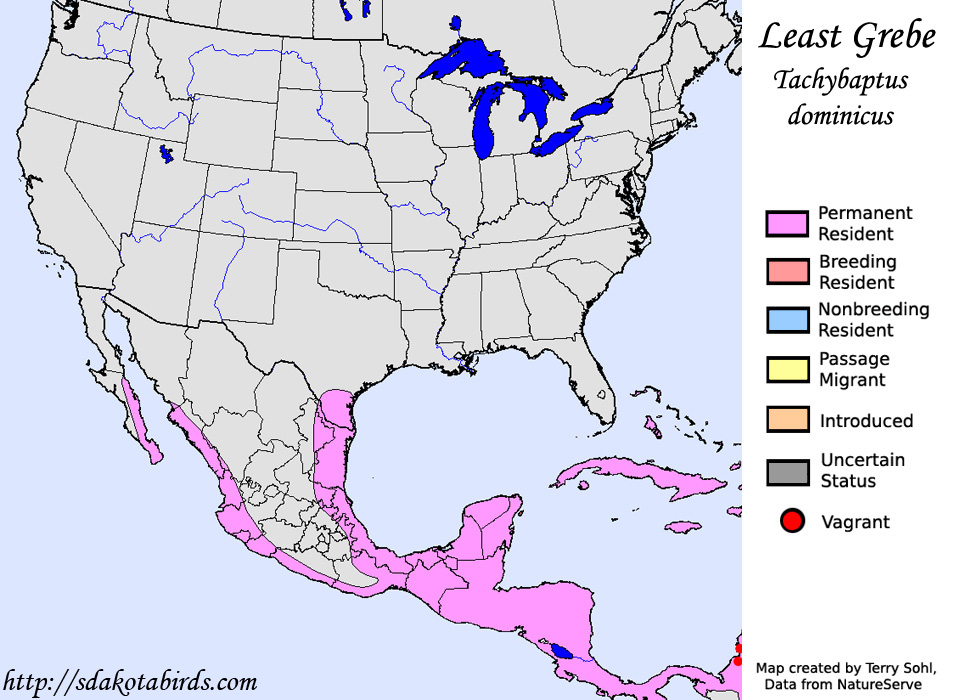
In May, I walked the long grassy trail around the ponds northwest of town, Pollywog Ponds.  The trail ends at the Nueces River, and then circles around the last pond to intersect with a 2nd pond.  There are THREE ponds..one has been dried up and forested with willow and oak trees ever since we've lived here in Texas.  The Least Grebe is a bit scarce, only reaching the upper southern coastal areas of the south in our state.  When and if I do see the least grebe, it is rarely a couple.  This mating season, I was lucky.  According to the Ornithology Lab:  "The smallest grebe in the Americas, the Least Grebe inhabits both temporary and permanent wetlands from south Texas to Argentina. Easily overlooked because of its size, coloration, and habits, it remains the most poorly understood of North American grebes."


LEAST GREBE
photos taken:  Pollywog Ponds - Corpus Christi, Texas
Habitat Map: Grebe


Now share your birding experiences:


For use of graphic link in your post, copy text in lavender text area below and paste into your blog post:


or use text linking only copy text in lavender text area below and paste into your blog post:

Table of Contents